PUBLICATIONS
WILD FIN
|
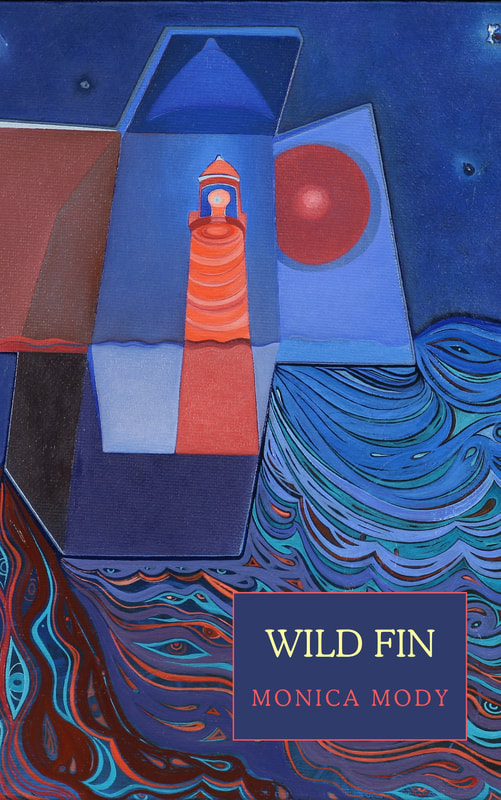
Wild Fin weaves the reader through an eclectic warp and weft of grief and fury, rupture and suture, mysticism and calls for climate and social justice. . . These poems demonstrate "writing's capacity to un-silence" with "words [that] flock together into language that will change skies. Maw Shein Win
Wild Fin feels like home while teaching us that home is a fabulation. Carrie Hunter
This book expands our understanding of how transspecies compassion must learn to swim in the dark and deep water of human migrations. Divya Victor
|
BRIGHT PARALLEL

|
Everywhere inside this book I found soil—living, dying, composting, growing, resting, and restless. I emerged from every page with some of it in my hands. Sumana Roy
Language bare as a rock, yet rich with the memory of ancestral call and body response, Monica Mody’s poems hold me steady through peril. Jeet Thayil
The voices we hear in Bright Parallel invite us to attend to the call of other beings, the call of things. These are the voices of oracles, priestesses, witches, guardians of spring, flame, shrub and tree. They offer us belonging rather than alienation, enchantment rather than despair. Ranjit Hoskote
Mody’s attunement to the natural world is precise, with room for both ‘mineral root’ and ‘whale praise’; a shocking openness to the elemental so that we, too, can imagine being flooded with the ‘courage of constellations’. Her feministic enquiry is utterly embodied . . . she draws all to the brink of the motherpool. Sampurna Chattarji
|
KALA PANI
|
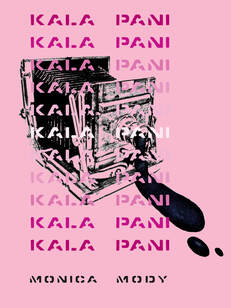
I keep handy a short list of writers who teach you that dreaming of a new politics is never enough. A new politics always needs a new language. That is the lesson offered by Arundhati Roy and Tony Kushner. After reading KALA PANI, my list also includes Monica Mody. Amitava Kumar
Gender, genre, national identity, multiple languages, and the body’s “natural” borders are all debased and reworked in this queer, unstable mix, which releases energy as it forms and breaks down and forms again. Joyelle McSweeney
With great inventiveness, Mody wends narrative around and within narrative, as though the bonds and bounds of story could twist, Houdini-like, to effect their own escape. . . . As witty and lightfooted as this book is, the shapeshifting characters function in an admonitory way, for no one ever truly gets away. Elizabeth Robinson in Rain Taxi
|
ORDINARY ANNALS

above/ground press, 2021
Buy the chapbook |
In her signature resonant and deeply grounded poetic style, Mody examines the limits of the body in all its many senses—as creative work, as organism, as site of protest, as political subject, as resident (of community, of nation, of habitat, of ecosystem, of Earth)—resulting in a prescient work that. . . “falter(s) towards a ripple, a ground of healing.” Iris Law on Lantern Review Blog
Ordinary Annals is the work of a poet attuned to the entanglement of word and world, memory and moment, love and suffering. |
ARTICLES, ESSAYS, CHAPTERS
"When Yoginis Appear with Animals: Animistic Relational Elements and the Non-Dual Matrix," Tarka Journal, Issue 7: On Tantra, March 2023
"Arts-based Practices: Research and Transformation in the Academy," Transformative Power of Art Journal, Volume 1, Issue 2, Winter 2023
"Transfiguration in the Aftermath of Fire: Monica Mody on Identity, Community, and LR," Lantern Review, Dec 2022
"Vision and Knowledge," Periodicities, Mar 2021
"Visionary Poetics," Action Books Blog, Oct 2020
Process Profile: Monica Mody on "Nani's Letter", Lantern Review Blog, May 2020
"Serpent, Earth, Healing, Initiation" in The Land Remembers Us: Women, Myth, and Nature--Proceedings of the Association for the Study of Women and Mythology, Vol. III, eds. Mary Jo Neitz and Sid Reger (Women and Myth Press, 2020): Read/download
"The Borderlands Feminine: A Feminist, Decolonial Framework for Re-membering Motherlines in South Asia/Transnational Culture," Integral Review Vol. 13 No. 1, Jul 2017
"Love as the Force of the Revolution: The Occupy Movement and Beyond" in Occupy Consciousness: Essays on the Global Insurrection (Evolver Social Movement, 2012) [PDF]
"Love as the Force of Revolution: The Occupy Movement and Beyond," Reality Sandwich, May 2012
"Double Vision: Revisiting the Container of the East West Encounter," The Journal of East-West Psychology Israel, Issue 1, March 2012
"Arts-based Practices: Research and Transformation in the Academy," Transformative Power of Art Journal, Volume 1, Issue 2, Winter 2023
"Transfiguration in the Aftermath of Fire: Monica Mody on Identity, Community, and LR," Lantern Review, Dec 2022
"Vision and Knowledge," Periodicities, Mar 2021
"Visionary Poetics," Action Books Blog, Oct 2020
Process Profile: Monica Mody on "Nani's Letter", Lantern Review Blog, May 2020
"Serpent, Earth, Healing, Initiation" in The Land Remembers Us: Women, Myth, and Nature--Proceedings of the Association for the Study of Women and Mythology, Vol. III, eds. Mary Jo Neitz and Sid Reger (Women and Myth Press, 2020): Read/download
"The Borderlands Feminine: A Feminist, Decolonial Framework for Re-membering Motherlines in South Asia/Transnational Culture," Integral Review Vol. 13 No. 1, Jul 2017
"Love as the Force of the Revolution: The Occupy Movement and Beyond" in Occupy Consciousness: Essays on the Global Insurrection (Evolver Social Movement, 2012) [PDF]
"Love as the Force of Revolution: The Occupy Movement and Beyond," Reality Sandwich, May 2012
"Double Vision: Revisiting the Container of the East West Encounter," The Journal of East-West Psychology Israel, Issue 1, March 2012
POEMS
"Forest-Restored," "Urban Walk" in periodicities: a journal of poetry and poetics, April 2024
"Glass House—Anthropocene" in Greening the Earth: A Global Anthology of Poetry (Penguin Random House India, 2023)
"Homing Instinct" in the other side of hope, volume 2, issue 2, winter 2022
"Mouthfuls," "Spirit of Regeneration," "Alchemy," "In Situ" in Touch the Donkey Issue 34, 2022
"stayed home with language" in Future Library: Contemporary Indian Writing (Red Hen Press, 2022)
Nine poems in The Penguin Book of Indian Poets (Penguin, 2022)
"Illegal" on Chaudiere Books Blog, April 2022
"Connection Poem" on Dusie: The Tuesday Poem, December 2021
"sometimes skin" in The Fabulist, August 2021
"Sarasvati" in An Exaltation of Goddesses: Poems for the Divine Feminine (Poetry Witch Press, 2021)
"Home As We Knew It Is Gone" in Witness: The Red River Book of Poetry of Dissent (Red River, 2021) Purchase in India | Purchase elsewhere
"Ocean Song" in Yearbook of Indian Poetry in English 2020-21 (Hawakal, 2021)
"Of What Are We Made," "Relative," "Friendship," "So, where will we begin today?," "Wild—," "Our Story," "nightwatchers," "Light rises like a torched moth," "We Lived as Rhythm," "Somatic" in Rigorous, Volume Four, Issue 4, 2020
“Timekeeper,” “Mirʁoʁ,” “I thought memory would be easy” in G U E S T #11, June 2020
"{deep ear to ground," "How We Emerge" in Almost Island, Monsoon 2020
"Promise," "Repair" in Hibiscus: poems that heal and empower (Hawakal Publishers, 2020)
"Nani's Letter" in Kajal Magazine, Feb 2020
"stayed home with language" on Burning House Press, Oct 2019
"Serpent Speaking," "Cunning Woman," "Ocean Song," "Prophecy: You Are Allowing Yourself to be Seen As Lit Up" in The Indian Quarterly, Oct-Dec 2019
"Nervous System" in Yes Poetry, Jun 2019
"The Witch on My Grandmother's Mountain" in Wyrd & Wyse Issue 4, 2018
"She" in Immanence Vol. 3 No. 1, Fall/Winter 2018
"Breath Hovers," "Flowers" in Mission at Tenth, Volume 6, Spring 2016
"Butterfly living in gentle clip" in Poetry International, Issue 20/21, 2015
"Resonance," "our faces collective as rage, snake," "Shadown" in Kitaab, Jun 2015
"on sensing and honoring the waters" in vitriol, No. 1, Jun-Oct 2014
"Red," "Myth of Knowing," "Myth of Light" (reprinted) in VAYAVYA, Spring 2014
"And sometimes," "Moon, this poem is for you," "Sita's Initiation" in MiPoesias, Feb 2014
"you'll think I's a slut" in Abraham Lincoln, Issue 8, Winter 2014
"The only true activity," "//this open to love//" Excerpt from The Love Book, "Food, A Madrigal," "Myth of Light," and a title in six parts:
1. Get off at the bus stop & it’s a short walk to the princess’s ivory tower.
2. The weather will change according to the things you find in the magic garden.
3. Memory will follow you on kitten feet in neat rows.
4. You will hang from her breast, a dusty icicle.
in Dusie, Issue 15, Jan 2014
"That I exist only as a speck on your bloodshot eyes but I am willing to sweat" in Everyday Genius, Jan 2014
Excerpts for Kala Pani in The &Now Awards 2: The Best Innovative Writing (Lake Forest College Press, 2013)
"DOMAIN INTIMACY" in Compost, Issue Two, 2013
Excerpts from Kala Pani and from The Love Book in 1913 a journal of forms, Issue 6, Oct 2013
"information blackout," "where only love" in Eleven Eleven, Issue 15, Sep 2013
"Red Rides Up Your Arm," "If this were home / Speak, she said," " To a Love Story (in Retrospect)" in Four Quarters Magazine, Aug 2013
"What we want to say is" in PIX: A Photography Quarterly, Aug 2013
Excerpt from Kala Pani in The Volta, July 2013
"The Rehabilitation of India Act of India" in Paragraphiti, June 2013
"this that takes shape" in The Bend, May 2013
"Not a Swan but a White Semi-Aquatic" in iARTistas #5, April 2013
"Myth of Loneliness," "Myth of the Wound," "Myth of the Muses" in Northeast Review, March/April 2013
"Not in my Name," "Rescue," "Shade a river blue," "I, or I" in The HarperCollins Book of English Poetry (HarperCollins India, 2012)
"Happiest in the 8-by-10" in Postcolonial Text, Vol. 7 No. 4, 2012
"Myth of Cosmos" in The The Poetry, November 2012 (audio)
"Tree, Woman" in Ginosko Literary Journal, Issue 12, 2012
"Myth of Soul" in Pyrta, Spring Issue #7, March 2012
"The Ride," "costumepolitanism, or how to live between worlds" in Upstairs at Duroc, Issue 13, 2012
"Myth of Spirits" in Lantern Review, Issue 4, Winter 2012
"Double Down" (collaboration with Jen Stockdale) in Horse Less Review #10, January 2012
Excerpt from The Love Book in RealPoetik, September 2011
"Tethered," "by our own standards / that are old standards" "On Stones" in Pyrta, Fall Issue #5, September 2011
"bootschrift" in Nether Print #3 & Fortnight #9, 2011
Excerpts from Kala Pani in Boston Review, January/February 2011
"it laps sensory (a crime)," "The Despair of the Peoples' Resistance" in West Wind Review, 2011
"scrambled matter" in The Bend, 2011
"At Lansdowne," "How We Turn Vulnerable," "The Daughter Said," "Calculating-" in Poetry with Prakriti Anthology 2007-2008 (Prakriti Foundation, 2010)
"Ensemble of the Most Sacred," "siege," "starts with a zero," "Affairs of the heart," "Self Defence" in Compost, 2010
"portable states" in Danse Macabre #41, November 2010
"Monica" in Horse Less Review #8, October 2010
"The Menace of the Inversely Touted Universal Deprivation" in apocryphaltext Vol. 4, September 2010
Excerpt from Kala Pani in LIES/ISLE 03, April 2010
"The Loose and the Sturdy are Dreaming" in Wasafiri Issue 61, March 2010
"An Tea" (Erasures of Jean Cocteau's film writings) in Cannot Exist Issue 6, March 2010
"How We Turn Vulnerable," "At Lansdowne," "The Daughter Said," " Diptych" in Pratilipi, July 2009
"Calculating--" in Chay Magazine, March 2009
"Affection for Normal Taboos" in Women. Period. (Spinsters Ink, 2008)
"Satan" in Midway Journal Vol. 2 Issue 6, September 2008
"Ghazal 607" in nthposition, March 2008
"How Is This For Stillness" in Kritya, January 2008
"A Letter for Shamail and Shahzina," "A Letter to Dom Moraes" in Naropa's SWP Magazine, Summer 2007
"The Mark" in The Little Magazine Vol VII Issue 1 & 2, July 2007
"Capacity" in DesiLit Magazine, Summer 2006
"Glass House—Anthropocene" in Greening the Earth: A Global Anthology of Poetry (Penguin Random House India, 2023)
"Homing Instinct" in the other side of hope, volume 2, issue 2, winter 2022
"Mouthfuls," "Spirit of Regeneration," "Alchemy," "In Situ" in Touch the Donkey Issue 34, 2022
"stayed home with language" in Future Library: Contemporary Indian Writing (Red Hen Press, 2022)
Nine poems in The Penguin Book of Indian Poets (Penguin, 2022)
"Illegal" on Chaudiere Books Blog, April 2022
"Connection Poem" on Dusie: The Tuesday Poem, December 2021
"sometimes skin" in The Fabulist, August 2021
"Sarasvati" in An Exaltation of Goddesses: Poems for the Divine Feminine (Poetry Witch Press, 2021)
"Home As We Knew It Is Gone" in Witness: The Red River Book of Poetry of Dissent (Red River, 2021) Purchase in India | Purchase elsewhere
"Ocean Song" in Yearbook of Indian Poetry in English 2020-21 (Hawakal, 2021)
"Of What Are We Made," "Relative," "Friendship," "So, where will we begin today?," "Wild—," "Our Story," "nightwatchers," "Light rises like a torched moth," "We Lived as Rhythm," "Somatic" in Rigorous, Volume Four, Issue 4, 2020
“Timekeeper,” “Mirʁoʁ,” “I thought memory would be easy” in G U E S T #11, June 2020
"{deep ear to ground," "How We Emerge" in Almost Island, Monsoon 2020
"Promise," "Repair" in Hibiscus: poems that heal and empower (Hawakal Publishers, 2020)
"Nani's Letter" in Kajal Magazine, Feb 2020
"stayed home with language" on Burning House Press, Oct 2019
"Serpent Speaking," "Cunning Woman," "Ocean Song," "Prophecy: You Are Allowing Yourself to be Seen As Lit Up" in The Indian Quarterly, Oct-Dec 2019
"Nervous System" in Yes Poetry, Jun 2019
"The Witch on My Grandmother's Mountain" in Wyrd & Wyse Issue 4, 2018
"She" in Immanence Vol. 3 No. 1, Fall/Winter 2018
"Breath Hovers," "Flowers" in Mission at Tenth, Volume 6, Spring 2016
"Butterfly living in gentle clip" in Poetry International, Issue 20/21, 2015
"Resonance," "our faces collective as rage, snake," "Shadown" in Kitaab, Jun 2015
"on sensing and honoring the waters" in vitriol, No. 1, Jun-Oct 2014
"Red," "Myth of Knowing," "Myth of Light" (reprinted) in VAYAVYA, Spring 2014
"And sometimes," "Moon, this poem is for you," "Sita's Initiation" in MiPoesias, Feb 2014
"you'll think I's a slut" in Abraham Lincoln, Issue 8, Winter 2014
"The only true activity," "//this open to love//" Excerpt from The Love Book, "Food, A Madrigal," "Myth of Light," and a title in six parts:
1. Get off at the bus stop & it’s a short walk to the princess’s ivory tower.
2. The weather will change according to the things you find in the magic garden.
3. Memory will follow you on kitten feet in neat rows.
4. You will hang from her breast, a dusty icicle.
in Dusie, Issue 15, Jan 2014
"That I exist only as a speck on your bloodshot eyes but I am willing to sweat" in Everyday Genius, Jan 2014
Excerpts for Kala Pani in The &Now Awards 2: The Best Innovative Writing (Lake Forest College Press, 2013)
"DOMAIN INTIMACY" in Compost, Issue Two, 2013
Excerpts from Kala Pani and from The Love Book in 1913 a journal of forms, Issue 6, Oct 2013
"information blackout," "where only love" in Eleven Eleven, Issue 15, Sep 2013
"Red Rides Up Your Arm," "If this were home / Speak, she said," " To a Love Story (in Retrospect)" in Four Quarters Magazine, Aug 2013
"What we want to say is" in PIX: A Photography Quarterly, Aug 2013
Excerpt from Kala Pani in The Volta, July 2013
"The Rehabilitation of India Act of India" in Paragraphiti, June 2013
"this that takes shape" in The Bend, May 2013
"Not a Swan but a White Semi-Aquatic" in iARTistas #5, April 2013
"Myth of Loneliness," "Myth of the Wound," "Myth of the Muses" in Northeast Review, March/April 2013
"Not in my Name," "Rescue," "Shade a river blue," "I, or I" in The HarperCollins Book of English Poetry (HarperCollins India, 2012)
"Happiest in the 8-by-10" in Postcolonial Text, Vol. 7 No. 4, 2012
"Myth of Cosmos" in The The Poetry, November 2012 (audio)
"Tree, Woman" in Ginosko Literary Journal, Issue 12, 2012
"Myth of Soul" in Pyrta, Spring Issue #7, March 2012
"The Ride," "costumepolitanism, or how to live between worlds" in Upstairs at Duroc, Issue 13, 2012
"Myth of Spirits" in Lantern Review, Issue 4, Winter 2012
"Double Down" (collaboration with Jen Stockdale) in Horse Less Review #10, January 2012
Excerpt from The Love Book in RealPoetik, September 2011
"Tethered," "by our own standards / that are old standards" "On Stones" in Pyrta, Fall Issue #5, September 2011
"bootschrift" in Nether Print #3 & Fortnight #9, 2011
Excerpts from Kala Pani in Boston Review, January/February 2011
"it laps sensory (a crime)," "The Despair of the Peoples' Resistance" in West Wind Review, 2011
"scrambled matter" in The Bend, 2011
"At Lansdowne," "How We Turn Vulnerable," "The Daughter Said," "Calculating-" in Poetry with Prakriti Anthology 2007-2008 (Prakriti Foundation, 2010)
"Ensemble of the Most Sacred," "siege," "starts with a zero," "Affairs of the heart," "Self Defence" in Compost, 2010
"portable states" in Danse Macabre #41, November 2010
"Monica" in Horse Less Review #8, October 2010
"The Menace of the Inversely Touted Universal Deprivation" in apocryphaltext Vol. 4, September 2010
Excerpt from Kala Pani in LIES/ISLE 03, April 2010
"The Loose and the Sturdy are Dreaming" in Wasafiri Issue 61, March 2010
"An Tea" (Erasures of Jean Cocteau's film writings) in Cannot Exist Issue 6, March 2010
"How We Turn Vulnerable," "At Lansdowne," "The Daughter Said," " Diptych" in Pratilipi, July 2009
"Calculating--" in Chay Magazine, March 2009
"Affection for Normal Taboos" in Women. Period. (Spinsters Ink, 2008)
"Satan" in Midway Journal Vol. 2 Issue 6, September 2008
"Ghazal 607" in nthposition, March 2008
"How Is This For Stillness" in Kritya, January 2008
"A Letter for Shamail and Shahzina," "A Letter to Dom Moraes" in Naropa's SWP Magazine, Summer 2007
"The Mark" in The Little Magazine Vol VII Issue 1 & 2, July 2007
"Capacity" in DesiLit Magazine, Summer 2006
COLLABORATIONS
"The Mueller Report as Poetic Text," a video collaboration between 150+ artists, 1913, September 2019.
"Myth of Spirits," 8x8 Collaborative Broadside with Lisa Bigalke, August 2012
"The Mueller Report as Poetic Text," a video collaboration between 150+ artists, 1913, September 2019.
"Myth of Spirits," 8x8 Collaborative Broadside with Lisa Bigalke, August 2012
EARLIER CHAPBOOKS
Old Maid & Her Mama (A Story of Crime & Passion), The Chapbook, 2011
SURFACES: a bilingual chapbook, Sarai, 2010
Travel & Risk, Wheelchair Party, 2010 (Recommended by Lantern Review editor Iris Law here)
SURFACES: a bilingual chapbook, Sarai, 2010
Travel & Risk, Wheelchair Party, 2010 (Recommended by Lantern Review editor Iris Law here)
REVIEWS
Tamiko Beyer's bough breaks (book review), Lantern Review Blog, August 2011
Barbara Jane Reyes's Diwata (book review), Lantern Review Blog, December 2010
S S Prasad's 100 Poems (book review), Lantern Review Blog, October 2010
Deepa Mehta's Water (film review), DesiLit Magazine, Winter 2006/2007
GUEST BLOGS
Rob McLennan's Poetry Spotlight Series on Medium
Zoe Tuck's Reading Blog
Lantern Review Blog
Montevidayo
NPM Daily
Rob McLennan's Poetry Spotlight Series on Medium
Zoe Tuck's Reading Blog
Lantern Review Blog
Montevidayo
NPM Daily
Sign up for news from Monica.