|
In view of some recent conversations, I have been thinking about the idiom of poetry: what it asks from its readers and supporters. Generosity rooted in curiosity—not judgment, but the willingness to explore/engage/expand with. (In that way, it can make us better humans, perhaps, if we live in that way in the world.)
To me, the best poetry comes out of a force that moves outside colonial, domesticated enclosures. Can its physicality stay liberated through all the modes of transmission?—that is the question. While reading poetry, if our bodies have not remembered the codes of energetic safety—and they come across poetry that threatens their equilibrium/status quo, they react and try to make the poetry safer. Safer poetry is not necessarily what our soul/the world soul needs. Leaning into the work of inner liberation that is continually inviting us into its play and process is also perhaps one of our responsibilities, so as to grow in community with poetry. As we liberate critical parts of us from the domination-based illusion, we allow poetry to move through us with the force of liberation.
0 Comments
What happens if instead of considering a part of our own/another's self 'wrong,' we become curious about it?
If, instead of filling words with predetermined meanings, we become curious about each other's experiences? What's going to moisten what has dried?—is it compassion, does it use another word? How do we relent, reclaim, ready ourselves, persist, reinfuse? At the introductory Women's Visionary Poetry and Fiction class (for CIIS Women's Spirituality)--
We dedicated our participation to grandmothers + our younger selves, partners + dads, teachers + foremother poets, the hidden ones. Told stories from the future. Were chosen by words carrying secrets. Readings included Alexis DeVeaux + Alexis Pauline Gumbs + Walidah Imarisha; Cecilia Vicuña; Mary Mackey; and more. To create a class is a little like creating a portal—and the beginning is the most exciting moment of all. Full of possibilities. 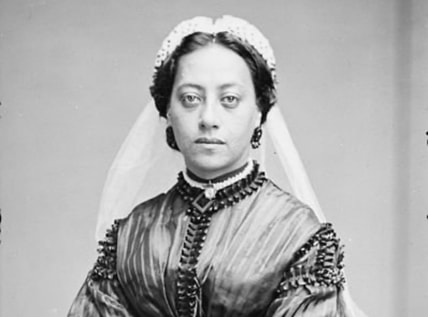 Mary Ellen Pleasant Mary Ellen Pleasant A few days ago, when I was first heard the story of Mary Ellen Pleasant, I did not know that the artist Cheryl Derricotte has been exploring Pleasant's life, biography, and legacy in her recent art projects. I wanted to go commune with Mary Ellen Pleasant, take her offerings. When I learned there would be a day-long excursion to important sites from her life and death in Napa, I had to sign up for the tour.* This was, no doubt, an invitation from spirit! During the tour—which was also an ancestral remembrance—we visited Pleasant's grave, made offerings of flowers and songs and poetry, poured libations and tears, told stories. I learned what an OG Pleasant was. The first Black female self-made millionaire in the 19th century. Conductor of the Underground Railroad, helper of women in travail. Practitioner of vodou who had studied with Marie Leveau. Author of three memoirs (now lost)... and so much more. Why was I learning about her after almost ten years of living in San Francisco? Ask history: who it makes room for, who is left out. 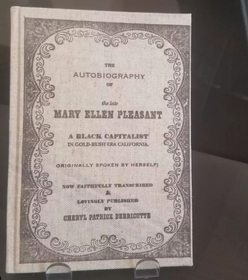 Cheryl Derricotte's book arts print project celebrating Pleasant is a part of the show Collecting Arising: The Insistence of Black Bay Area Artists, co-curated by Ashara Ekundayo and Lucia Olubunmi R. Momoh, and up at the Museum of Sonoma County until Nov 27. Folks in the Bay Area, do visit if you get a chance - the whole show is exceptional.
(*The tour was hosted by Derricote, Ekundayo, and Momoh, in conjunction with the Collective Arising show.) Sometimes I feel this deep restlessness in regard to writing. It's not a new feeling. I've felt it on the edge of my teeth for years now—this greasy feeling. When words swell too much with the meanings located in stale, commonplace contexts... and I want to throw off their thick rough cloak and reveal... not just another layer... but the growling, bare-teethed heart of it all. So sharp that it tears off all the stories of separation our world is awash in.
So tender. So unafraid of being not clever. Cleverness—a habit I picked up as I grazed academic writing—it was long before that, wasn't it? What have you taken on that bears you away from the white hot center of your own need? The most urgent, the most un-clever need of all is the hunger for connection to the universal, beating heart. No distraction can distract us away from it. Every distraction tries to succeed. To go beyond cleverness, then. Is this a good question to frame about a piece of writing: whether it opens, extending in a space beyond cleverness? There is no beginning nor end to the Void. And yet, the ordinary psyche knows so well to pull back at the faintest flicker of (its) death. Another question to ask myself when writing: Am I copying someone else's style sheet, thought forms—or letting myself interact with the forms that are arising out of the interaction of this moment with space? How do I strip off everything I've known? All of it? Perhaps I want to make a distinction between the knowns that take my breath away with how familiar they are—in such an epistemic relational process, I find I am recovering something of myself—and the external influences that beglamor, and seek to shift me away from my authority. I know all too well words can create vibratory ladders. It is easy to shift them this way or that. Words can be easily promiscuous—subtle shapeshifters where something stirs just out-of-sight. It matters—the intent we bring to words. Where is our gaze resting, what has it entangled with? Words—as crutches—can crush. May our words be bridges. Words can be exceptional connectors between personal consciousness and source consciousness. What brick walls need to fall down to make way for all of these links? Words have often been the tools of the architects of false realities, fear-based realities. For words to be bridges—between silence and that other place—always becoming, divine, the source from which potential comes into form—they must be hard-won, like pressed coal. Not cleverly thought out. Nor artless. In contact. Remember the lioness who has to live out her life in an arena that is already too small for her? Don't be like her. Writing is a way of materializing self. Not a pre-existing self. A self that is streaming with the earthstream and starstreams. With the waters of life. Sending love, courage, power to all the Partition researchers, storytellers, poets, artists who are remembering and writing of an India/South Asia that was not divided by borders drawn up by a colonial government. Recuperating the stories of these pasts is particularly necessary in the light of the pall of hypernationalism that appears to have descended upon South Asia. May the healing of our memories call in collective healing.
A part of the story of the experiences of the Partition of India within my motherline is in my PhD dissertation,"Claiming Voice, Vitality, and Authority in Post-secular South Asian Borderlands." Some of the poems written in reclaiming voices from silence are in Bright Parallel, my forthcoming poetry collection from Copper Coin. When we can lean into the awareness that there are multiple perspectives in the world, we are less likely to be lured by the need to be right and make others wrong.
Can you see the energy that mode of thinking traps? Energy that can unstop creativity, collaborative innovations! What patterns of thinking, feeling, moving, stilling would you need to shift to embrace the idea of a world in which multiple perspectives exist? How many people have you diminished/demonized for not thinking like you? Whose humanity are you willing to return? Which parts of your own soul will you retrieve when you return to others their full humanness? This transcript is cut from an interview that aired on KPFA on April 11, 2022, in which Brenda Salgado and I spoke with Women's Magazine producer Lisa Dettmer. The transcript has been lightly edited for clarity. With thanks to Ruby Kaur for the transcription. Lisa Dettmer So welcome Monica Mody and Brenda Salgado. Thank you for making the time today. I wanted to talk to you both together because there's so much in common between the two of you and the work you do. Both of you are involved in a feminist spirituality that is body-based and relational and also involved in reclaiming your Indigenous knowledge of your foremothers and healing the trauma that people of color suffer from under this racialized, capitalist patriarchy. And in addition, you both cite queer, Chicana feminist Gloria Anzaldúa as an influence on your work. That's an amazing amount of coincidences. So I thought since I was trying to find out where to go start this, maybe we could start with Anzaldúa's work and how she's important to each of you. I know Monica, you use a lot of Anzaldúa's work in your dissertation, in life, especially her work around Borderlands and in-between consciousness and healing the split of consciousness. Also, you're transporting it. You're making it transnational as it relates to the colonization of your homeland and our minds. Can you talk about that and how her work is important to you? Monica Mody Absolutely. Coming across Gloria Anzaldúa's work really changed the trajectory of how I was approaching my scholarship, to begin with. She, as a scholar, was bringing in her relationship with the spirit worlds—who she called the “los espiritus,” this very alive world that she was in contact with—all her spiritual experiments and experiences, and she wasn't just doing that. She was very aware that this was something that for her was a decolonial experiment. It was something that allowed her to go beyond the wounds that were inflicted on her person and on her cultural person and on her community because of colonization. So she talked a lot about how as a scholar, she found herself in a field where there wasn't space for her to name these experiences that she was having. And as I read her, something opened up in me. I realized that this is what I had been missing until now. I had been coming into scholarship from a more fragmented and fragmentary perspective, and Anzaldúa gave me permission to go in and embrace all of myself, including aspects of my experiences that are not rational; aspects of my experience that are not specializable. Aspects of my experience that are not only centered in a deconstructionist point of view. So she was very instrumental in my thinking. I'll just begin there and I may bring her back later. 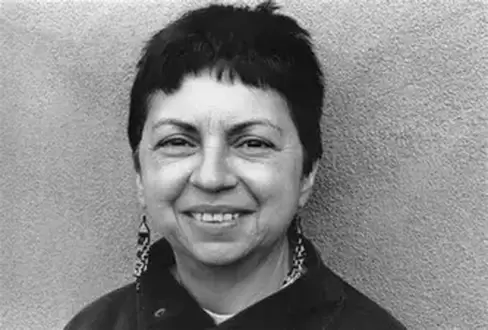 Gloria Anzaldúa Lisa Dettmer Well, I wanted to go into that a little bit more because I don't know how much people realize Western philosophy is a discourse that influences everything about us and that this alternative, feminist way of knowing includes a way of knowing that it's been excluded from modern, Western philosophy. What you talked about, the so called rational way of knowing that sees the world in dualities of light and dark, good and bad is as you said, a fragmented reality with rigid categories and dualities, and it creates the self and other, which is also a colonization. I'm wondering if you can talk about that, specifically, and how that was important to your decolonization. Monica Mody What we have now come to know as 'the West' is a result of a lot of ideological battles that started and resulted in what became the Age of Enlightenment. So that particular discourse of rationality came to coalesce around that time. Why that happened is beyond the scope of this interview, but one of the major results of that battle of ideologies was, as you've named, a splitting off in reality. So, yes, light and dark; woman and man; rationality and intuition; body, mind, spirit; you name it. There was something that was happening which I think can really be located in anxieties around control—not just that, but also the desire to produce realms of control upon certain bodies. So as a result of the split, there were people who were considered to be the ideal subjects of modernity, ideal subjects of Western modernity. And then there were people who were considered to be the Others of modernity. Pretty much all of European colonialism also came about because these splits had already entrenched themselves in some ways in the consciousness of the Western psyche. They made it possible and they exacerbated it. If the people who are being colonized were not even seen as human enough because they were 'others'—they were categorizable only as something so far away from the imagination of the ideal construct that the only way to be in relationship with them was to rule them, to dominate them—that's the story of colonization. And of course, it's a story that repeated itself throughout the globe, in many parts of Asia, Africa, Latin America. Anzaldúa comes to it as Latina/Chicana woman. And she brings her own experience from standing at the borders, looking at—okay—what happened? How were the Indigenous realities left out of what's come to be recognized as the ideal Western construction of reality? And I noticed a similar parallel in India, where the situation is a little bit different because in some ways, we are no longer colonized. In 1947, the British colonialists left India, left the land. And, at the same time, 'postcolonial' implies that the impact of colonization is over, but that's actually not the case. I talk about this in my scholarly work—that alongside the processes of colonization was the emergence of a certain kind of nationalism, a certain kind of nationalistic identity, which was in some ways feeding on the same splits. One of the other splits in the colonial mind or in the colonial modern mind, so to speak, is that between 'the sacred' and 'the secular.' Secularism under this definition is seen as completely removed from the everyday [religious] experiences of the human being in some ways. It's something that's opposed to the domain of religion. What that ends up doing is that our relationship with the living world no longer has a place in how we are in our day-to-day governance. And when I use the word 'governance,' I don't just mean because of governments that are being formed, but also how we are governing our day-to-day lives. So that split between the sacred and the secular was something I saw operating very clearly in how I was viewing reality; what I thought was permissible for me to talk about, whether as a scholar or as a feminist or as an artist—in all domains of my experience. And Anzaldúa busts all of those walls. She's like, well, the only way we can address reality is by really approaching it as something that's non-binary—and she talks also about the third horizon of consciousness. The third horizon is neither this nor that—it's when you bring the two together, it's something beyond either of these two sides of the conflict or sides of perception speaking. It's something beyond all of that. And so that's where wholeness emerges from. Lisa Dettmer Monica, you also mentioned this when you talked about borderlands, when you explained that multiplicity or intersectionality isn’t the same as borderlands because it doesn’t mean that there isn’t non-hierarchical relationships or a sense of relationality. So I thought that was very interesting, that you brought that in. And I know that you’re also engaged in what you call a feminist critical hermeneutics, that is reclaiming and remembering the knowledge of your foremothers and ancestors through what you call an autohistoria. Which is an unearthing of the silence of women that happens through the violent creation of nation-states, partitions and borders. And it’s also a way of creating relationship, so we’re back to that fundamental concept, also, of relationship. So I was wondering if you could talk a little bit about the concept of relationship to your foremothers, your ancestors, and the need for autohistoria. Monica Mody When I started this journey, when I first encountered Anzaldúa’s work, when I first encountered Schussler-Fiorenza’s work—who is the scholar who talks about feminist critical hermeneutics--I was really coming from this place of absence and loss in a way. For me, in my personal experience, there was disruption in connection with my motherline in feeling a sense of continuity in tradition, traditional knowledge, belonging, feeling connected to my ancestresses. So I found the words for it through some of the scholars and ancestresses that I encountered, and through the process of writing itself—that’s how I discovered the language. Earlier I had been aware that something was missing, maybe a piece of my heart was missing, maybe pieces of my soul were missing, but I wasn’t aware what it was. So it was in undertaking this journey that I realized, okay, certain memories, I call them 'memories of power and energy' in my dissertation, they needed to be called back. Certain relationships with my ancestresses and relationships with my motherline needed to be called back for me to be able to reclaim my own voice, vitality and authority. But also as Brenda herself says, when we’re doing this work, we’re not just doing it for ourselves. We’re really doing it for the collective, we’re doing it for the cultures that we’re a part of, whose healing we want to be a part of. All of these can shift when you’re engaged in this process. For me, recognizing that if I’m not engaged in an individualist project, part of my work also needs to be a reconstruction of cultural memory—this is where the work of the imagination comes in, which is a work of relationship. Memory work, imaginative work is relationship building. You have to tend to these figures. You have to tend to these presences. You have to tend to these spirits. And I came to it through my scholarly writing, but I also came to it through poetry, and I found myself coming to know certain figures that had not really been part of my consciousness through this work. At the same time, I finished the doctoral dissertation in 2019, and this is not work that is over by any stretch of the imagination. It's morphed a little bit more. I found that it’s almost like, layers or initiations—so going through the doctorate was one kind of initiation. Once I went through that, I realized, okay now I’m able to host more knowledge. When I say 'knowledge', I’m not just talking about it in a disembodied way. I’m really talking about it in that old way, in that wisdom-tradition way, where knowledge is relationship. You can only come into knowledge when you are in right relationship. 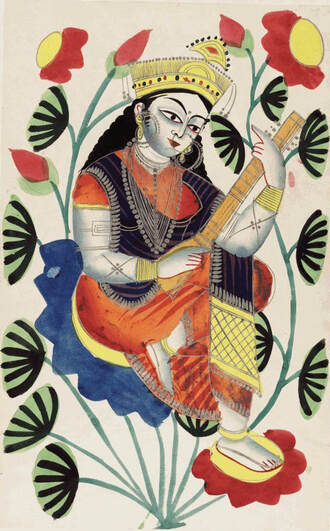 Sarasvati So I needed to renew my relationship, for instance, even with the figure of Sarasvati. I needed to renew my relationship with the figure of Kali. I needed to renew my relationship with the figures of yoginis. These are all ancestal figures. What’s happened in India, in South Asia, is that there is a very monolithic kind of discourse at play right now. The nationalist, fundamentalist paradigm wants not just women but everyone to look a certain way, speak a certain way, be a certain way, and if you don’t fit in, you don’t belong. And there are very clear parameters of belonging and no belonging. So this is what the reconstruction or the memory work really muddies, because, for instance, Sarasvati is really important in the nationalist discourse, but the Sarasvati I am making contact with and I am reclaiming for myself—that I am evoking through my words—and words are very sacred—so hopefully I am imbuing with life the memory of Sarasvati for the collective—she’s very different than the Saraswati that the nationalist discourse wants to construct as the exemplar goddess. For me, she is wisdom, but she is also wildness. She’s that primordial connection with the waters. She’s that primordial connection with the source. So that’s one aspect of this work, as someone for whom words are the primary way in which I make relationship—and of course, all the practices that Brenda mentioned, they have been so important for me as well. Because, again, those practices are earth-connected, they come out of the Earth and they remind us that she is the first mother. She is the first mother. That’s also our oracular connection in a way, because all these practices are reminding us that the body’s wisdom and the earth’s wisdom are tremendous. Far more mysterious that we can hold here in our head. So there’s all those sets of practices, which, again, I feel have been important for me to reclaim, and at the same time, one of my primary contributions is through words—recognizing that words are living and we’ve forgotten that. Somehow, too, to remember that and reclaim that. Lisa Dettmer Well, you mentioned in one of your talks that that poets and shamans are the same figure in indigenous society. So it's specific kinds of words that have a specific kind of magic. Monica Mody Absolutely. In parts of Africa, for instance, it was well known that when spoken in a certain way, you have to be—the concept of right relationship doesn't go away, right?—so when spoken in a certain way, embracing a certain stance, words give life. This calls you to be careful of the vibrational frequencies that your words are setting up. Also in South Asia, for instance, one of the early names for poets in Sanskrit and the the early names for seers were the same: rishis, rishikas. The one who sees, and the one who brings it forth through the kavya, through poetry. Again, it's a concept that's well known in indigenous systems around the world. Lisa Dettmer And you also use dance. You said in one of your talks that body based disconnection prevents one from being an agent of change. And then you've danced to connect to your body, but also to your culture. And you talk about the importance of dance in some spiritual dances in Hindu culture that women do. Did you want to talk about that? Monica Mody Yeah. When I was a child, I trained in two forms of classical dance. I trained in Kathak and in Bharatanatyam. Kathak comes from North India, and Bharatanatyam comes from South India. And that training actually started because there's a story that my family tells of how, when they were visiting another town, we were all in a park, and suddenly, little Monica could not be found anywhere. Everyone was asking, What happened to her? And they found me in the midst of a circle of people—there was music playing, and I was dancing. This little kid who was completely without self-consciousness, who was dancing away. And so they started me on this dance training. Now what happens in dance training, unfortunately—it's connected to some of the other ideologies which are also part of the culture around shame, body shame—so it was good and bad. I reconnected to dance again when I moved to the Bay Area. It was visionary information that was given to me in a medicine ceremony: I was told that I needed to dance once a week. It was very precise: here is your spine! The spine and the serpent became motifs that were important to my doctoral work later as well. Because of that message I received, I decided—okay, I have to take dance seriously. I would go to the dance floor—one of those conscious dance spaces—and I started releasing a lot. For me it was a way of releasing the trauma and the blockages, the energy blockages, things that were stored—as things started getting cleared out of my energy field, I started making contact with different presences—ancestral presences and source and the goddess. It became this very beautiful transmutational practice that was a part of my work. And, while that was happening, I was also writing my dissertation, which could have been something that kept me locked up in the domain of the head. I realized that the two practices together changed my dissertation. Dance allowed the dissertation itself to become something that was way more fluid than it would have been if I hadn't had that very embodied practice of being in touch with the body, and letting energy move through the body. That became another motif that I had to bring through. I realized that for me, and for many people—women and men and people of other genders—the codes of disconnection are stored in the body. So in order to break through those codes of disconnection, you have to find a way to speak to the body—and dance can be a way. In South Asia, people know this, in folk festivals and cultures. Dance is often a part of ritualistic coming together. So there is that. What's sometimes forgotten is that it's a sacred activity, too. So, for instance, even the classical dance that I learned as a child--Bharatanatyam—comes from the devadasis. The devadasis were temple dancers, they were dancing in service of the divine, in service of the goddess, in service of the god. In pre-colonial times, that was their sacred role. Then, with colonization, that had to be broken because for coloniality the kind of connection that allowed the culture to be transmuted into something higher could not be allowed to remain. So the devadasis had to be demonized. They had to be pushed to the margins of society, their role as priestesses had to be denied and decried. So I see my dancing also as part of that lineage—of reclamation. 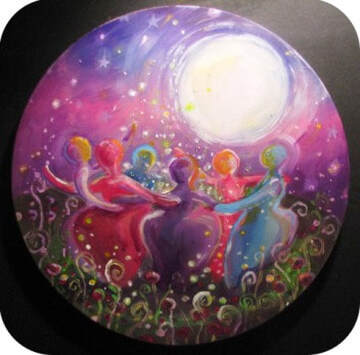 Lisa Dettmer
What’s important about working in circles with women, celebrating womanhood and the importance of ritual? Monica, is there anything you would like to add before we close? Monica Mody Yes, I would love to say a couple of words about ritual and about circles. The word 'ritual' is etymologically connected to the Sanskrit word rit or ritu--which on the one hand means rhythm, nature's rhythm. On the other hand, the word ritu is connected to menstruation, menstrual cycles. Nature's cycles and menstrual cycles. So, for me, ritual is this beautiful, beautiful way to come into relationship with the earth. And, again, a knowing that's innate in us—we already know how to do it. When we let the 'smart' part of persona drop! Here, in our bodies, we already know, because we are of the Earth. And this knowing is something that's been so important for me to claim for myself, because in South Asia/India, in what is known as Hindu culture, there is an overemphasis placed on intermediaries between you and the divine. It is the priests that are supposed to tell you how to go to the divine, how to speak to the divine. So, for me, the knowing that I don't need an intermediary--I Am That—that's been huge. I have gone to sacred sites in India and done rituals in secret, or rituals away from the eyes of the villagers or other local people, knowing that it's something that's very, very transgressive that I am doing; that if somebody sees me, I would get into trouble. But that transgression is what allows me to access the aliveness of the goddess, of Shakti, in that moment. So that one aspect to it. And in terms of the circle: I wrote a piece on yoginis, which is both a scholarly commentary and a long poem. While I was writing it, I really found myself—not puzzled, but holding this beautiful koan: the yogini as a spiritual practitioner by herself, but also the yoginis in a circle. (A lot of the times, there are supposed to be 64 yoginis, but there are other numbers named in different textual traditions.) I realized that it's one of those things that the modern mind puzzles over: one and the many. But also the form of the circle begins from shunya—begins from the void. The circle is the source, the circle is the beginning, the circle is where it all emerges from and comes out of. We don't have to choose one or the other but, I believe, ideally we would be able to be these spiritually sovereign beings individually, and in collectivity—in the circle. I've been thinking today about Carol Sanford's "Do Good" paradigm—such an easy unconscious trap, where we make certain calls about what is good and right to do based on our values and then extend that to everyone/everything. We think we are making a difference, but we have not been able to move out of individualistic or disconnected "I"-centered or small "we"-centered solutions.
At least there is the intention to make a difference. There are also those that appear to do good. For instance, Jaggi Vasudev's save soil campaign. Yes, it does not break out of the traps that Sanford mentions—universalization, genericity, projections (remember that colonialism also thought of itself as doing good, when saving the savages)—but there is another layer to the story. The story of Isha Foundation's own murky history: how it acquired tribal land, stole indigenous ecological knowledge: "Once this knowledge was transferred, they were abandoned and, since they were ‘illegal trespassers, it was the ashram members, armed with the traditional tribal knowledge that they had accessed in an underhand way, who were given access to the forest and its bounty." Or, how it built illegally—over, and obstructing, elephant corridors: "A key reason Isha has got away with blatantly violating rules is that it has been enabled by political authorities, particularly the Tamil Nadu government." In other words, through collusion with that age-old partner of unexamined power: corruption. Can we trust ecological leadership by personages and organizations that continue to wreak damage on rivers and animals, bury indigenous voices, threaten indigenous livelihood? Will the world please take note? Vasudev's spiritual teachings are an entirely different matter. Or are they? When you claim to be a teacher on behalf of consciousness, can you let small matters such as these slide? The principle of interconnectedness is clear: the integrity of the how affects the what. From a living systems perspective, small is not only beautiful, it is a system nested within the whole, and therefore its well-being is essential to the well-being of the whole. The lack of congruence between Vasudev's eco-discourse and eco-doings makes sense if it is true: the gaping hollow in his philosophy. Relying on another's study and inner work without putting in work of our own cannot grow us, nor can it provide structures or organizations with integrity enough to uphold an evolutionary consciousness that truly desires the participation of or contributes to all life. Conflict is the touchstone that shows me how close I want to keep a relationship. Does the person pull back? Hide? Become defensive and belligerent? Certain things crush the vital spirit—mine too, I've learned—so, paying attention, I listen and disengage.
But once we have moved through that raw gaze together—and done our best—there is an intimacy: we've seen each other's intention. That is where energy begins from again and again. That is the art of returning each other—and ourselves—to innocence. |
Get updates of New blog postsconnect with meArchives
April 2024
|
 RSS Feed